

Artificial intelligence is everywhere in construction technology.
Dashboards are smarter. Search is faster. Systems connect through APIs. Platforms promise instant insights.
But here’s the hard truth:
Most construction AI tools aggregate data.
They don’t govern it.
And aggregation without governance does not create clarity.
It scales confusion.
The Illusion of Connected Intelligence
Today’s leading construction platforms connect systems through APIs.
They pull data from:
- RFIs
- Submittals
- Change orders
- Financial systems
- Design platforms
- Field reports
On the surface, this looks powerful.
Everything is connected.
Everything is searchable.
Everything is “AI-enabled.”
But here’s the problem:
If inconsistent data connects to inconsistent data, AI does not create alignment.
It amplifies inconsistency.
Bad data connected to bad data is still bad data — just faster.
For billion-dollar capital programs, 80% accurate answers are not enough.
Executive decisions require defensible intelligence.
Aggregation vs. Governance
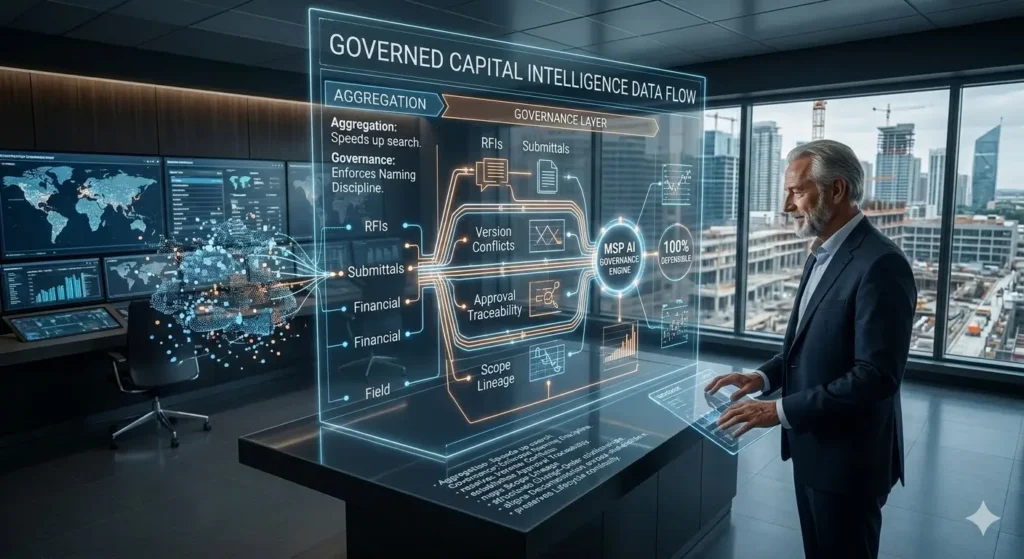
Aggregation:
- Moves information.
- Connects systems.
- Surfaces documents.
- Speeds up search.
Governance:
- Enforces naming discipline.
- Resolves version conflicts.
- Establishes approval traceability.
- Maps scope lineage.
- Structures change-order relationships.
- Aligns documentation across stakeholders.
- Preserves lifecycle continuity.
Aggregation is technical.
Governance is strategic.
Why Governance Changes Economics
In complex infrastructure programs, decision latency compounds cost.
When executives cannot immediately answer:
- Where did capital move?
- What triggered this change?
- Who approved it?
- What is the cumulative impact?
- What are the third-party implications?
Meetings multiply.
Exposure grows.
Narrative control weakens.
Structured governance turns project data into decision-ready intelligence.
That changes velocity.
And velocity changes economics.
MSP AI: Built on Structured Capital Intelligence
MSP AI does not begin with APIs.
It begins with discipline.
Before AI activation, we enforce:
- Version-controlled documentation
- Time-stamped approval lineage
- Linked RFIs, ASIs, submittals, and change orders
- Cross-platform normalization
- Structured LEED documentation tracking
- Lifecycle-ready archive integrity
Only then does AI become conversational.
Only then does it deliver answers — not guesses.
Because AI is only as powerful as the data behind it.
Defensible Intelligence Matters

In public-private capital programs, documentation is not just operational.
It is legal.
It is financial.
It is political.
It is reputational.
Aggregation helps teams find files.
Governance protects ownership.
That is the difference.
The Future of Infrastructure AI
The next phase of AI in construction will not be about more connections.
It will be about structured capital governance.
Executives will not ask:
“What platform are you using?”
They will ask:
“Is your data decision-ready?”
AI aggregates data.
MSP AI governs it.
And governed data makes projects answer.
Make This a Strategic Advantage
If you are leading a capital program exceeding $250M, and your current AI tools rely on aggregation without governance, the risk is compounding.
Schedule a confidential executive briefing to evaluate your capital intelligence maturity.
Because in billion-dollar development, 80% clarity is not enough.
CMO Note:
This blog does four things:
- Separates you cleanly from Procore-style AI without naming them.
- Educates executives at a strategic level.
- Positions MSP AI as governance-first infrastructure.
- Reinforces your premium pricing narrative.
Now the next strategic question:
Do you want to follow this blog with a companion piece:
“Why 80% Accuracy Is Dangerous in Billion-Dollar Projects”
That would deepen the differentiation further.
Before the Next Decision
For capital programs, uncertainty is expensive.
If your data cannot withstand executive scrutiny in real time, it is already a liability.
Request a private capital intelligence assessment to identify where governance gaps are compounding risk — and where structured intelligence can change outcomes.

No responses yet