Why AI agents are reshaping workflows—and what will actually matter moving forward
There’s a structural shift happening in construction technology, and it’s bigger than a typical software upgrade.
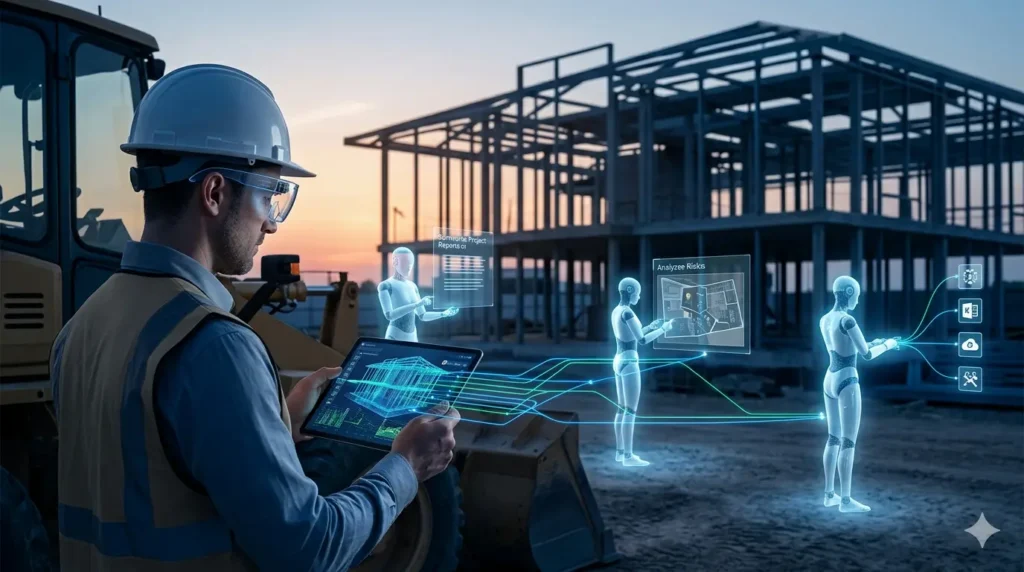
Artificial intelligence is no longer just supporting workflows. It’s beginning to execute them.
Tools powered by platforms like ChatGPT and Claude are evolving into systems that can interpret information, connect multiple tools, and carry out tasks with minimal human input.
This raises a critical question:
If AI can handle the workflow, what role does construction software play next?
From workflow tools to intelligent systems
Most construction platforms today are built around structured, repeatable processes—RFIs, submittals, reports, schedules, and logs. These are essential, but they are also predictable.
That predictability is exactly what makes them easy for AI to replicate.
We are already seeing this happen:
- Reports can be summarized instantly
- Risks can be identified without manual analysis
- Insights can be generated across multiple data sources
What used to be a competitive product feature is quickly becoming standard.
As a result, the advantage is shifting away from the workflow itself.
What AI cannot replace
If workflows are becoming automated, then long-term value doesn’t sit in the tool—it sits in what powers it.
That is data.
But not just any data. The most valuable data in construction has specific characteristics:
- It reflects what is actually happening on-site
- It is difficult to capture and validate
- It cannot be generated artificially
- It is continuously updated over time
AI can process information, but it cannot create reliable real-world context on its own. Without strong inputs, even the most advanced system will produce limited results.

Two industry shifts happening at once
Construction is being reshaped by two major developments that are happening simultaneously.
A shift toward real-world visibility
For years, decisions have been based heavily on documents. But documents don’t always reflect actual site conditions.
The industry is now moving toward:
- Visual documentation
- Field-driven updates
- Real-time context
- Spatial and location-based data
This marks a transition from assumption-based decision-making to evidence-based execution.
The rise of agentic AI
At the same time, AI is becoming more autonomous.
Modern systems are now capable of:
- Pulling data from multiple platforms
- Analyzing project conditions
- Executing multi-step workflows
- Supporting faster, real-time decisions
These capabilities are still evolving, but adoption is accelerating quickly.
Where the real opportunity sits
The real transformation is not just about AI, and it is not just about better tools.
It is about the combination of both—powered by structured data.
AI agents rely on context to function effectively. In construction, that context comes from understanding:
- What has been completed
- What is currently happening
- What has changed over time
Without this level of visibility, AI operates with gaps. With it, AI becomes significantly more powerful.
Why dashboards are no longer enough
For years, construction technology platforms competed on analytics—dashboards, reports, and insights.
That advantage is no longer as strong.
AI can now:
- Generate summaries instantly
- Build insights on demand
- Interpret structured data without custom-built features
This shifts the focus from:
“What can the software show?”
to
“What data does the system actually have?”
The shift toward data-first platforms
Construction technology is moving beyond standalone tools into something more foundational.
Data-first platforms are emerging as the new standard. These platforms:
- Connect disconnected systems
- Structure project information
- Provide a reliable source of truth
- Enable AI-driven workflows
In this model:
- Tools become interchangeable
- Workflows become flexible
- Data becomes the core asset
Where MySmartPlans fits in
Construction projects generate a large volume of information across documents, drawings, communications, compliance records, and field updates.
The challenge is not the lack of data—it is the lack of structure.
Information is often:
- Scattered across multiple systems
- Difficult to access quickly
- Hard to validate with confidence
MySmartPlans brings this data together into a structured, connected environment. This allows teams to work more efficiently while also preparing for the integration of AI into everyday workflows.
Rather than replacing existing systems, MySmartPlans ensures that the data within them works together seamlessly.
Because in an AI-driven environment, disconnected data is more than inefficient—it limits what teams can actually do.
What this really comes down to
AI will continue to improve. Workflows will become faster, more automated, and less dependent on manual input.
But none of that works without reliable data.
In construction, the real advantage will not come from having more features. It will come from having a clearer understanding of what is actually happening on-site.
Decisions are made based on reality, not just reports.
And the organizations that can capture, structure, and connect that reality will define how construction operates moving forward.
Build on better data
MySmartPlans helps bring clarity, structure, and visibility to your project information—so your team can make faster decisions today and stay ready for what comes next.
No responses yet