
The Power of Data in Supporting and Preventing Insurance Claims
In today’s design and construction environment, insurance is no longer just a backstop. It is a measure of discipline.
Professional liability premiums are rising. Deductibles are increasing. Coverage terms are tightening. Underwriters are scrutinizing risk management protocols with greater intensity, especially on complex projects delivered through design build and progressive delivery models.
And when a claim happens, one factor determines the outcome more than any other:
The quality and defensibility of your project data.
For architecture and engineering firms, structured documentation is no longer administrative overhead. It is risk infrastructure.

Claims Begin With Ambiguity, Not Negligence
Most professional liability claims in architecture and construction do not originate from recklessness. They arise from ambiguity.
- Incomplete construction documentation
- Version confusion
- Unclear scope boundaries
- Poor revision tracking
- Coordination breakdowns
- Gaps between design intent and field execution
- Inadequate asset turnover documentation

Ambiguity expands liability.
On large civic, aviation, healthcare, and stadium projects, ambiguity is amplified by scale. Hundreds of consultants. Thousands of submittals. Continuous revisions. Compressed schedules. Public visibility.
In these environments, documentation is not administrative. It is structural.
Clear document control and defensible project data reduce construction risk exposure and strengthen professional liability defense.
The Strategic Decision Every Project Makes
Every major construction project makes a choice, whether it articulates it or not:
Build with protection.
Or bank on the change order game.
The change order game assumes ambiguity will be resolved through negotiation. It assumes disputes can be absorbed. It assumes responsibility can be redistributed when problems surface. It assumes documentation gaps will not become leverage in litigation.
This model may create short term flexibility. But it produces long term exposure.
Building with protection is different. It requires:
- Clear scope definition
- Structured revision lineage
- Version discipline
- Audited submittal tracking
- Field verified documentation
- Lifecycle ready asset intelligence
One strategy relies on negotiation leverage.
The other relies on proof.
Insurance carriers increasingly reward firms that operate with structured documentation systems and formal QA processes.
The New Reality of Professional Liability Insurance
The professional liability risk landscape has changed significantly.
Design build delivery has shifted risk allocation. Responsibility lines between architect and contractor are less distinct. Digital collaboration tools accelerate decision making while increasing coordination risk.
As a result, insurers are asking harder underwriting questions:
- How is document control governed
- What QA and QC protocols are formalized
- How are revisions validated and tracked
- How is coordination risk mitigated
- What protects the firm from expanded financial responsibility
Firms that cannot demonstrate structured answers are priced accordingly through:
- Higher professional liability premiums
- Increased deductibles
- Restricted limits
- Aggressive exclusions
Insurability is now directly tied to documentation discipline.
When a Claim Happens, Evidence Wins
In a construction claims environment, memory does not matter. Intent does not matter. Verbal assurances do not matter.
Defensible construction documentation must be:
Evidence matters.
- Time stamped
- Version controlled
- Indexed across disciplines
- Audited for completeness
- Structured for rapid retrieval
- Verified against field conditions
When documentation is fragmented or inconsistent, defense becomes expensive. Firms are forced to reconstruct project history. Internal emails become primary evidence. Ambiguity becomes vulnerability.
Many architecture firms are drawn into financial exposure not because they were negligent, but because they cannot conclusively prove their position.
The difference between exposure and protection is often a clean documentation trail.
The Financial Cost of Disorganized Project Data
Poor documentation discipline creates cascading financial impact:
- Higher professional liability insurance premiums
- Increased deductibles
- Longer litigation timelines
- Costly forensic reconstruction
- Erosion of client trust
- Reduced competitiveness in risk sensitive RFPs
Insurance companies price risk based on uncertainty.
Uncertainty lives in disorganized data.
Conversely, structured project intelligence signals control, governance, and reduced exposure.
The Long Tail Risk Few Firms Anticipate
Construction claims increasingly emerge years after ribbon cutting.
Facilities underperform. Systems fail. Maintenance responsibilities are disputed. Public scrutiny intensifies.
When asset documentation was incomplete or poorly structured at turnover, architects and engineers may be pulled back into disputes long after the project team has dispersed.
Long tail liability is one of the most underestimated risks in the industry.
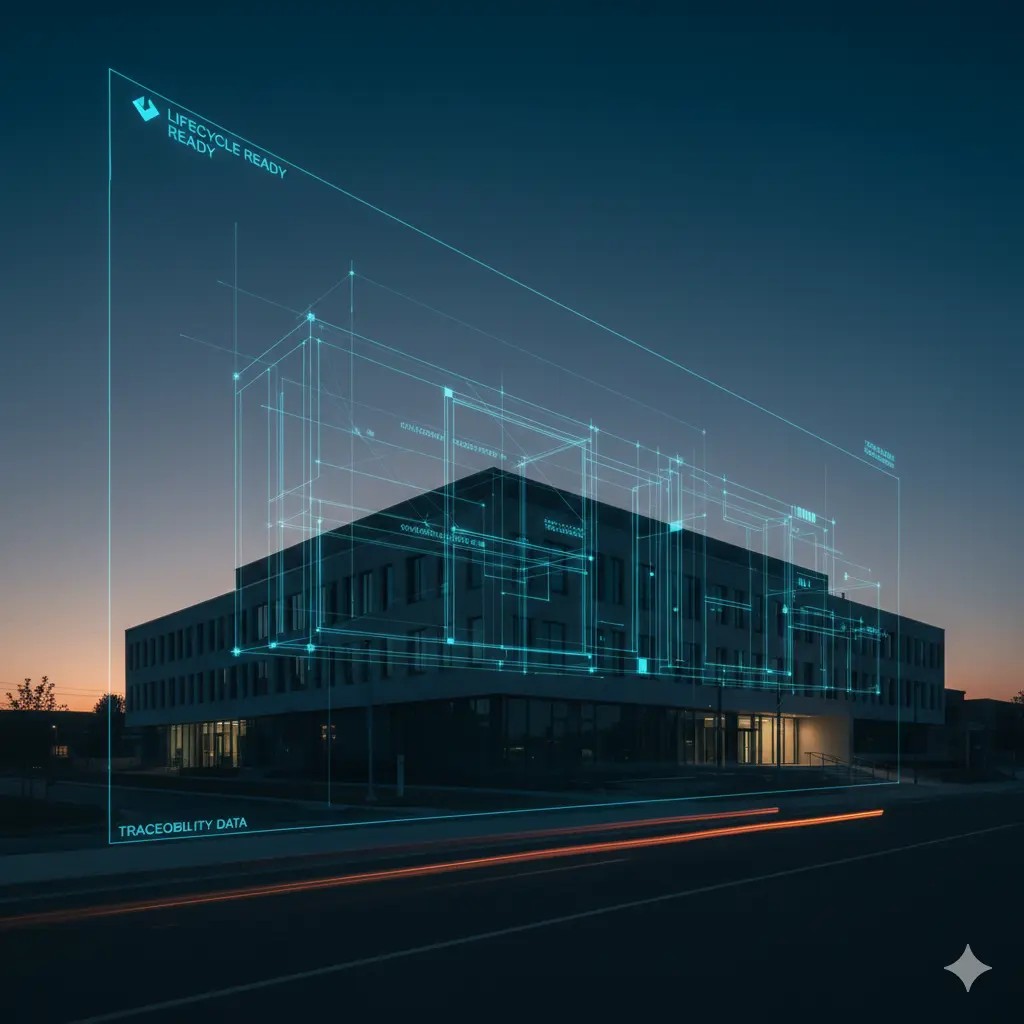
Lifecycle ready documentation that is structured, verified, and archived dramatically reduces that exposure.
From Document Storage to Risk Infrastructure
There is a fundamental difference between storing files and building risk infrastructure.
File storage is passive.
Risk infrastructure is intentional.
True risk infrastructure includes:
- Governance over documentation structure
- Clear revision lineage
- Submittal audit protocols
- Cross discipline indexing
- Dimensional validation
- Asset traceability from design through operations
It transforms documentation from a compliance requirement into a strategic shield.
Firms that treat documentation as risk infrastructure gain leverage in three arenas:
Underwriting
Demonstrating disciplined QA systems and document control governance.
Litigation
Producing immediate, defensible evidence.
Client Trust
Delivering transparency and lifecycle accountability.
The Competitive Advantage of Protection
On high profile projects such as stadiums, airports, hospitals, and civic landmarks, reputation is as valuable as revenue.
When disputes arise, firms with structured project intelligence respond with clarity.
When insurers evaluate risk, disciplined firms negotiate from strength.
When clients select partners, lifecycle accountability differentiates.
Protection becomes a competitive advantage.
The Bottom Line
Every construction project reflects a strategic choice:
Build on negotiation leverage.
Or build on documentation discipline.
One depends on how well you can argue.
The other depends on how well you can prove.
In today’s risk environment, proof wins.
Data is not administrative overhead. It is financial protection. It is legal defense. It is underwriting leverage. It is reputational insurance.
The power of data lies not simply in what it contains, but in how defensibly it is structured.
Because when a claim arises, clarity wins.
And clarity is built long before the claim is filed.
No responses yet